Marvell’s stock surges on news of Google chip deal — and Broadcom’s falls
Source Entity
Emily Bary
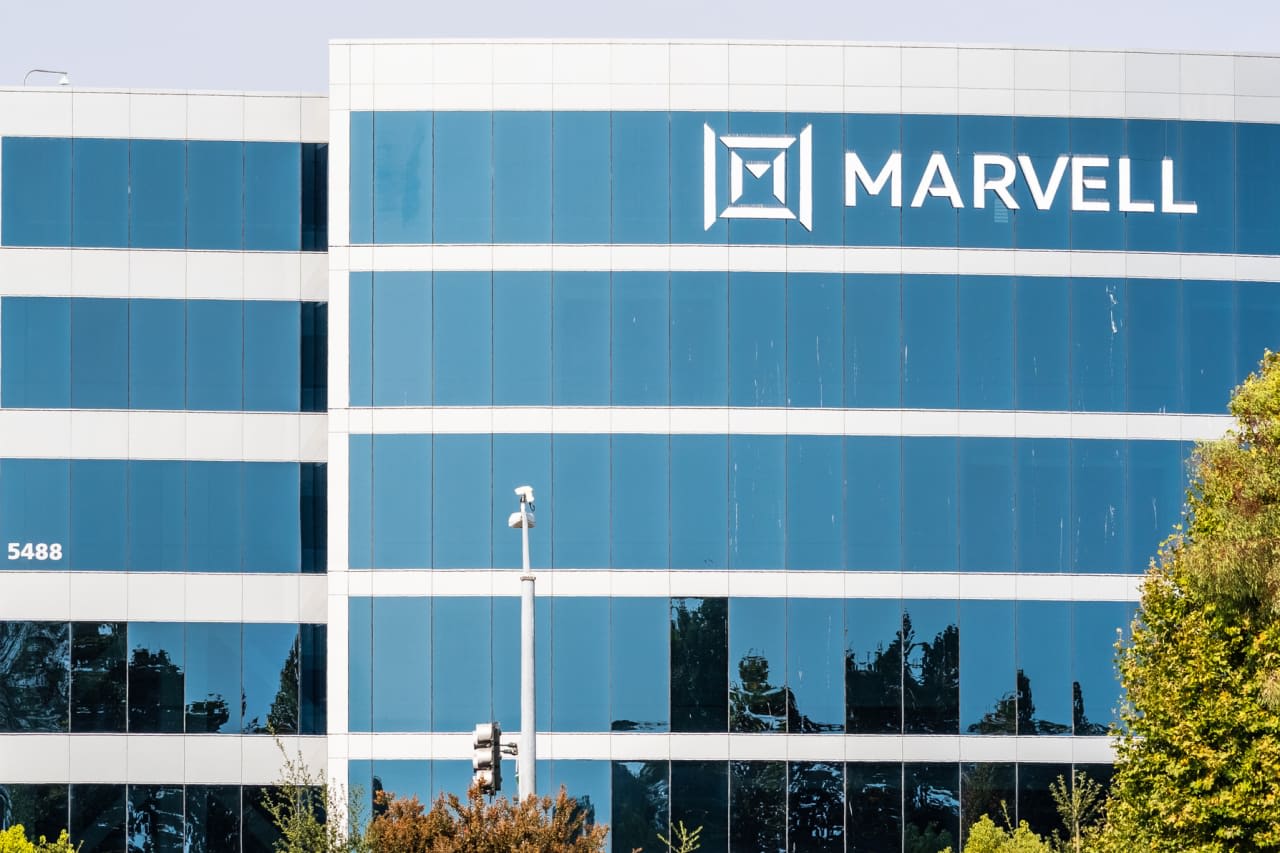
Marvell Technology shares surged 6% following a strategic partnership announcement with Google centered on custom AI chip development. The deal includes an option for Google to acquire up to $12.2 billion in Marvell shares through 2033.
Strategic Realignment in the AI Semiconductor Market
Marvell Technology has experienced a significant market rally, with shares jumping 6% following the announcement of an expanded strategic partnership with Google. This collaboration is centered on the co-development of custom silicon, specifically tailored to integrate with Google’s existing Tensor Processing Unit (TPU) ecosystem. As part of the agreement, Google has secured the option to purchase up to $12.2 billion worth of Marvell stock—specifically 58,970,907 shares at a price of $206.58 per share—through the 2033 fiscal year. This long-term commitment underscores the deepening reliance of major cloud providers on specialized infrastructure to power the next generation of artificial intelligence.
The Shift Toward Custom Silicon
The move by Google reflects a broader, industry-wide trend where hyperscale cloud providers are aggressively pursuing custom chip designs to improve computational efficiency. By moving away from a "one-size-fits-all" approach, companies like Google are seeking to reduce their dependency on traditional dominant market players, such as Nvidia. The agreement with Marvell specifically targets the development of AI inference accelerators, storage controllers, and network interface controllers, which are essential components for optimizing the performance of large-scale machine learning models.
Financial Implications and Market Dynamics
While Marvell’s stock surged on the news, the broader semiconductor market saw divergent reactions, with competitors like Broadcom facing downward pressure. The scale of the $12.2 billion investment option signifies a high-stakes bet on the longevity and scalability of the partnership. By tying the share purchase to specific purchasing targets through 2033, both companies are creating a symbiotic relationship that incentivizes technological milestones and production volume, effectively locking in a supply chain roadmap for the next decade.
Technological Synergy: The TPU Ecosystem
At the heart of this deal is the integration of Marvell’s intellectual property into the TPU ecosystem. As AI models become increasingly complex, the bottleneck for performance is often found in data movement and storage rather than just raw processing power. Marvell’s expertise in high-speed connectivity and data infrastructure makes them a natural partner for Google. By co-developing products that specifically "attach" to the TPU architecture, the partnership aims to lower latency and improve power efficiency, which are critical metrics for maintaining a competitive edge in the cloud infrastructure market.
Future Trends in AI Infrastructure
Looking forward, this partnership highlights the transition of the semiconductor industry toward a more collaborative, bespoke model. We can expect to see more "co-design" agreements where cloud giants partner with specialized chipmakers to maintain control over their hardware stacks. As the demand for generative AI continues to grow, the ability to rapidly iterate on custom silicon will define the winners and losers in the cloud space. This deal serves as a blueprint for how tech conglomerates will likely secure their supply chains and technological capabilities in the years leading up to 2033.
Verification Required?