The Crisis of the Average
Generative AI is a mirror, not a source. It operates by calculating the most probable next pixel or word based on a trillion existing examples. The result is a seductive, polished average—what I call algorithmic beige. While the output is technically proficient, it lacks the jagged edges, the intentional mistakes, and the lived experience that define a true creative voice. When we rely on these tools for the core of our expression, we risk blending into a global sea of homogeneity where everything looks professional but nothing feels essential.
In my fifteen years in the industry, I have seen this tension play out in studios from Tokyo to Berlin. The current debate isn't about whether AI can 'create'—it can. The real friction lies in the devaluation of the process. I have sat in boardrooms where executives argue that a 90% accurate AI generation is 'good enough' for a campaign, ignoring the fact that the remaining 10% is where the soul, the subversion, and the cultural relevance actually live. That 10% is the human signature.
Prerequisites: What You Will Need
Protecting your voice is not a passive act. It requires a conscious decoupling from the 'efficiency' mindset that drives most AI adoption. Before you implement the following steps, ensure you have the following foundations in place to avoid falling into the trap of prompt-dependency.
- A curated archive of your pre-AI work to serve as a baseline for your creative DNA.
- A defined set of personal constraints (e.g., a limited color palette or a specific rhythmic structure).
- An analog sanctuary—a physical space or toolset where screens are forbidden.
- A willingness to produce 'ugly' work during the iterative phase.
Why the focus on 'ugly' work? Because AI is designed to skip the awkward phase of creation. It jumps straight to a polished version. But for a human practitioner, the awkward phase is where the discovery happens. If you are afraid of the mess, you will instinctively lean on the AI to clean it up, and in doing so, you will erase your own signature.
Step-by-Step: Isolating and Protecting Your Signature
- Audit Your Creative DNA: Review your last five years of work. Identify the recurring patterns, the specific flaws you tend to repeat, and the themes that haunt your work. These are not mistakes; they are your signature. Document these as 'Non-Negotiables' that no AI output should be allowed to overwrite.
- Introduce Analog Friction: Force yourself to move the project through a non-digital medium. Sketch on paper, record a voice memo, or build a physical maquette. This breaks the feedback loop of the screen and introduces the unpredictability of the physical world—something the World Intellectual Property Organization (WIPO) notes is central to the debate over human authorship (Source: WIPO, 2023).
- Develop a 'Human-First' Workflow: Use AI only for the 'drudge work'—formatting, resizing, or basic research. Never use it for the 'spark' phase. If you use AI for ideation, you are essentially letting a statistical average decide the direction of your vision.
- Curate a Personal Style Guide: Create a living document of your aesthetic values. Instead of prompting an AI with 'in the style of [Famous Artist],' prompt yourself with 'how would I solve this if I only had charcoal and ten minutes?'
- Build a Provenance Trail: Keep a meticulous log of your iterations. Save the failed sketches, the rejected drafts, and the messy notes. In a world of instant generation, the proof of work—the evidence of the struggle—becomes the primary marker of value.
"The value of art in the age of AI will shift from the final image to the narrative of its creation. We are moving from an economy of results to an economy of provenance."— Industry Consensus on the Shift Toward Process-Based Value
This shift is already visible in global markets. In Japan, the concept of Wabi-sabi—finding beauty in imperfection—is becoming a strategic defense against the sterile perfection of AI-generated design. By leaning into the 'glitch' or the hand-drawn line, creators are signaling their humanity to an audience that is increasingly starved for authenticity.
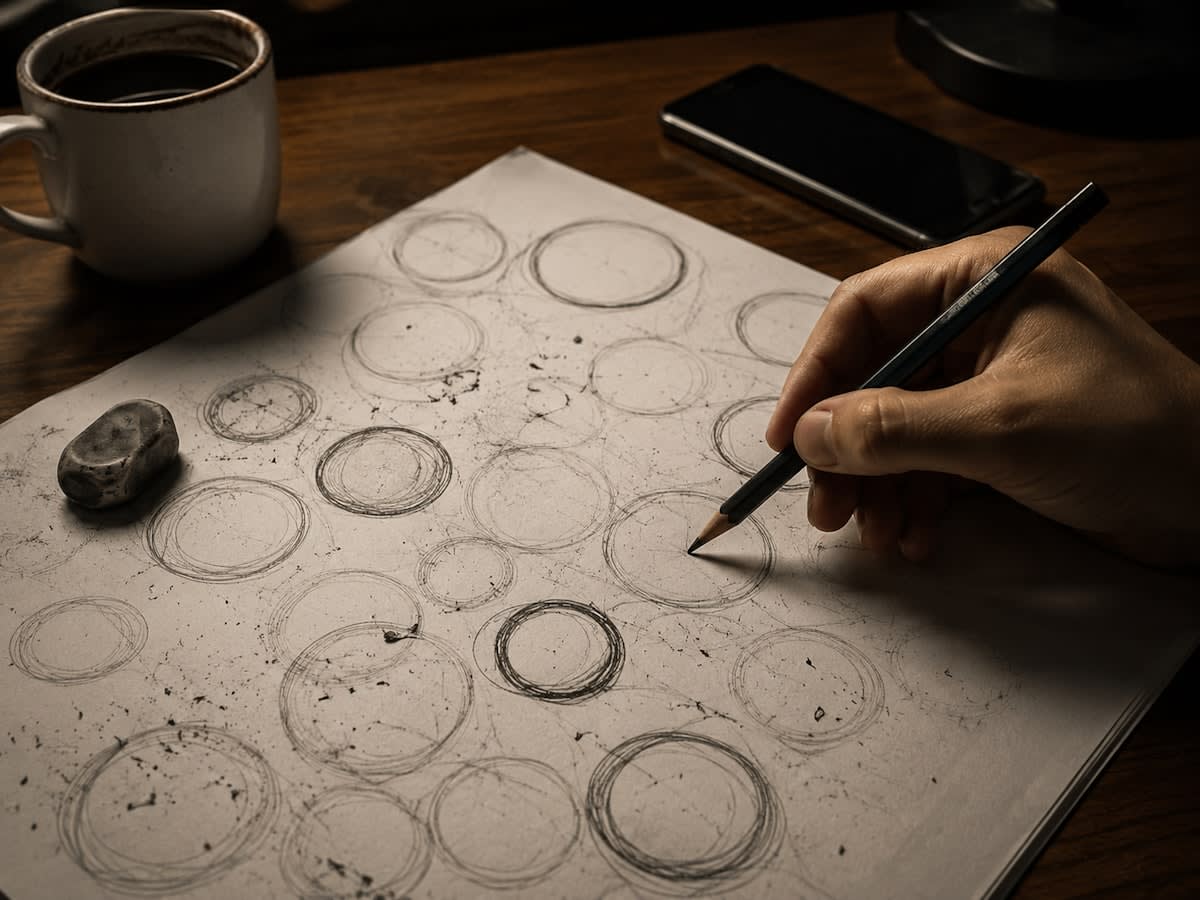
When I implement this workflow with my clients, the biggest hurdle is usually the fear of slowing down. We have been conditioned to believe that speed is the ultimate metric of productivity. But speed is the enemy of voice. To protect your signature, you must be willing to be inefficient. You must be willing to spend three hours on a detail that an AI could 'solve' in three seconds, simply because the three hours of thinking change the way you see the problem.
Common Pitfalls to Avoid
The most dangerous trap is the 'Ideation Loop.' This happens when a creator uses AI to generate ten ideas, picks the best one, and then spends the rest of the project refining it. While this feels efficient, you have outsourced the most critical part of the creative process: the conceptual leap. You are no longer the architect; you are the editor of a machine's suggestions.
Another pitfall is 'Style Sanitization.' AI tends to smooth over the eccentricities of a style to make it more palatable. If you find yourself using AI to 'clean up' your work, ask yourself if you are removing the very things that make the work yours. The goal is not to reach a state of perfection, but to reach a state of truth.
Fact-Check & Accuracy Note
This guide is based on 15+ years of practitioner experience in the arts and media sector. References to the World Intellectual Property Organization (WIPO) reflect ongoing global discourse regarding authorship and AI. Because the field of Generative AI evolves weekly, the strategies provided focus on timeless principles of creative agency rather than specific software versions.